

What is the difference between a butt weld reducing tee and a forged reducing tee?
Jan 05, 2026
Leave a message
Hey there! As a supplier of Butt Weld Reducing Tees, I often get asked about the differences between butt weld reducing tees and forged reducing tees. It's a pretty common question in the industry, and I'm here to break it down for you in a way that's easy to understand.
What are Butt Weld Reducing Tees?
First off, let's talk about butt weld reducing tees. These are a type of pipe fitting that's used to connect three pipes of different diameters. The "butt weld" part means that the tee is welded directly to the pipes, creating a strong and leak - proof connection.
Butt weld reducing tees are made by cutting and welding pieces of pipe together. This process allows for a high degree of customization. You can get them in a wide range of sizes and materials, like carbon steel, stainless steel, and alloy steel. They are widely used in various industries, including oil and gas, chemical processing, and power generation. If you're interested in learning more about them, check out this Butt Weld Reducing Tee page.
What are Forged Reducing Tees?
On the other hand, forged reducing tees are made through a forging process. Forging involves heating a piece of metal and then shaping it using compressive forces, usually with a hammer or a press. This process gives the tee a very dense and uniform grain structure, which makes it extremely strong and durable.
Forged reducing tees are often used in high - pressure and high - temperature applications. They can handle more stress than butt weld reducing tees and are less likely to fail under extreme conditions. They are also available in different materials, but they tend to be more expensive due to the complex forging process.
Key Differences
Manufacturing Process
The most obvious difference is the manufacturing process. As I mentioned, butt weld reducing tees are made by cutting and welding pipe sections. This process is relatively straightforward and can be done in a standard welding shop. It allows for quick production and easy customization.
Forged reducing tees, however, require specialized forging equipment. The forging process is more time - consuming and requires skilled workers. The metal has to be heated to a specific temperature and then shaped precisely, which adds to the cost and production time.
Strength and Durability
Forged reducing tees have a clear advantage when it comes to strength and durability. The forging process aligns the grain structure of the metal, making it stronger and more resistant to fatigue. This means that forged tees can withstand higher pressures and temperatures without deforming or cracking.
Butt weld reducing tees are strong enough for most general applications. However, in high - stress situations, they may not be as reliable as forged tees. The welded joints in butt weld tees can be potential weak points, especially if the welding is not done properly.
Cost
Cost is another major difference. Butt weld reducing tees are generally more affordable. The raw materials are relatively inexpensive, and the manufacturing process is less complex. This makes them a popular choice for projects with a tight budget.
Forged reducing tees, on the other hand, are more expensive. The cost of the forging equipment, the skilled labor, and the longer production time all contribute to the higher price. But if you need a tee that can handle extreme conditions, the extra cost may be worth it.
Size and Customization
Butt weld reducing tees offer more flexibility in terms of size and customization. Since they are made by welding pipe sections, it's easy to create tees with different diameters and lengths. You can even get custom - made tees to fit your specific requirements.
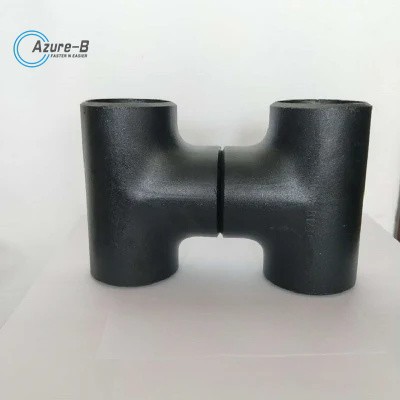

Forged reducing tees are more limited in terms of size and customization. The forging process requires specific molds, and it can be difficult and expensive to create custom molds for non - standard sizes.
Applications
Butt weld reducing tees are commonly used in general plumbing systems, water treatment plants, and low - pressure industrial applications. They are also a popular choice for small - scale projects where cost is a major concern. For example, in a small chemical processing plant, butt weld reducing tees can be used to connect pipes of different sizes without breaking the bank.
Forged reducing tees are typically used in high - pressure and high - temperature applications, such as oil refineries, power plants, and offshore drilling platforms. In these environments, the reliability and strength of the forged tees are crucial to prevent leaks and ensure the safety of the operation.
Quality Standards
Both butt weld reducing tees and forged reducing tees need to meet certain quality standards. For butt weld tees, the ASME B16.9 Unequal Tee standard is often used. This standard specifies the dimensions, tolerances, and material requirements for butt weld tees.
Forged tees also have their own set of standards, which are usually more stringent due to their use in high - stress applications. These standards ensure that the forged tees can withstand the extreme conditions they are designed for.
Conclusion
In conclusion, the choice between a butt weld reducing tee and a forged reducing tee depends on your specific needs. If you're working on a project with a limited budget and normal operating conditions, butt weld reducing tees are a great option. They offer good strength, flexibility in size, and are relatively inexpensive.
However, if you're dealing with high - pressure, high - temperature, or critical applications, forged reducing tees are the way to go. They provide superior strength and durability, even under extreme conditions.
As a supplier of Butt Weld Reducing Tees, I can offer you high - quality products at competitive prices. If you're interested in purchasing butt weld reducing tees or have any questions about them, feel free to reach out for a quote and start a procurement discussion.
References
- ASME B16.9 standard documentation
- Industry research on pipe fittings and their applications