

What is the weight of a welded 90 deg elbow of a certain size?
Jul 01, 2025
Leave a message
What is the weight of a welded 90 deg elbow of a certain size?
As a supplier of welded 90 deg elbows, I often get asked about the weight of these essential pipe - fitting components. Understanding the weight of a welded 90 deg elbow is crucial for various reasons, including shipping, installation, and structural design. In this blog, I'll delve into the factors that influence the weight of these elbows and how to calculate it for a given size.
Factors Affecting the Weight of Welded 90 Deg Elbows
Material
The material used to manufacture the welded 90 deg elbow is one of the most significant factors affecting its weight. Common materials include carbon steel, stainless steel, and alloy steel. Each material has a different density, which directly impacts the weight of the elbow. For instance, carbon steel is relatively dense, so a carbon - steel welded 90 deg elbow will generally be heavier than one made from a lighter alloy. Stainless steel, while also dense, may have different weight characteristics depending on its specific grade.
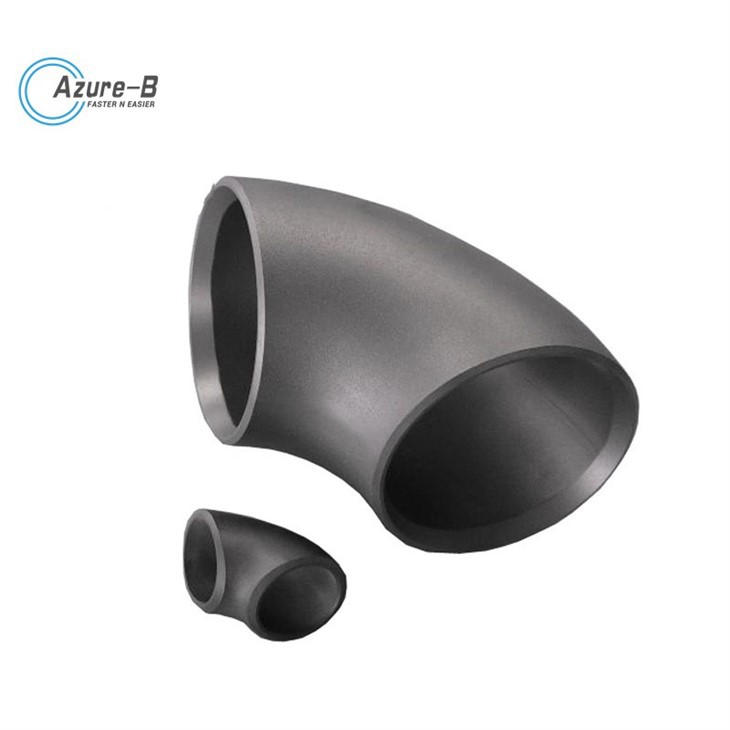

Size
The size of the welded 90 deg elbow is another critical factor. Size is typically defined by the nominal pipe size (NPS) and the schedule. The NPS indicates the approximate inside diameter of the pipe that the elbow will connect to, while the schedule refers to the wall thickness. A larger NPS elbow will naturally weigh more than a smaller one, and an elbow with a thicker wall (higher schedule) will also be heavier. For example, a 10 - inch NPS elbow will be much heavier than a 2 - inch NPS elbow, and a schedule 80 elbow will weigh more than a schedule 40 elbow of the same NPS.
Manufacturing Process
The manufacturing process can also influence the weight. Welded elbows can be made through different methods, such as seamless or welded construction. Seamless elbows are generally more uniform in structure, but the welding process used in welded elbows can add a small amount of weight due to the additional weld material.
Calculating the Weight of a Welded 90 Deg Elbow
To calculate the weight of a welded 90 deg elbow, we can use a formula based on the volume and density of the material. The volume of a 90 - degree elbow can be approximated as a section of a torus. The formula for the volume of a torus segment (which represents the 90 - degree elbow) is:
[V=\frac{\pi}{4} \times (D^2 - d^2)\times C]
where (D) is the outer diameter of the elbow, (d) is the inner diameter, and (C) is the center - to - end dimension of the elbow.
Once we have the volume, we can calculate the weight using the formula (W = V\times\rho), where (\rho) is the density of the material. For example, the density of carbon steel is approximately (7850\ kg/m^3).
Let's take a practical example. Suppose we have a 4 - inch NPS, schedule 40 carbon - steel welded 90 deg elbow. The outer diameter (D) of a 4 - inch NPS schedule 40 pipe is (114.3\ mm), and the inner diameter (d) is (102.3\ mm). The center - to - end dimension (C) for a standard 90 - degree elbow is usually calculated based on industry standards. For a 4 - inch NPS elbow, (C) is approximately (152.4\ mm).
First, we calculate the volume:
[V=\frac{\pi}{4}\times((0.1143)^2-(0.1023)^2)\times0.1524]
[V=\frac{\pi}{4}\times(0.01306 - 0.01046)\times0.1524]
[V=\frac{\pi}{4}\times0.0026\times0.1524\approx 0.00031\ m^3]
Then, using the density of carbon steel (\rho = 7850\ kg/m^3), the weight (W) is:
[W=V\times\rho=0.00031\times7850\approx 2.43\ kg]
Importance of Knowing the Weight
Shipping
When it comes to shipping, the weight of the welded 90 deg elbow is a key consideration. Shipping costs are often calculated based on weight, so knowing the exact weight helps in accurate cost estimation. Overestimating or underestimating the weight can lead to unexpected shipping expenses or delays.
Installation
During installation, the weight of the elbow affects the equipment and labor required. Heavier elbows may need more robust lifting equipment and additional manpower to install safely. Structural supports also need to be designed to handle the weight of the elbow and the fluid or gas it will carry.
Structural Design
In structural design, the weight of the elbow is factored into the overall load - bearing capacity of the piping system. Engineers need to ensure that the pipes, supports, and other components can withstand the combined weight of all the elbows and the fluid within the system.
Our Product Range
As a supplier, we offer a wide range of welded 90 deg elbows in different sizes and materials. For those interested in a 1.5" 90 Degree Elbow, we have high - quality options that meet industry standards. Our Seamless 90° Pipe Elbow provides a smooth and uniform flow path, and our ANSI B16.9 90 Degree Buttweld Elbow is designed to be easily welded into existing piping systems.
If you are in need of welded 90 deg elbows for your project, whether it's for a small - scale plumbing job or a large - scale industrial application, we are here to assist you. Our team of experts can help you select the right elbow based on your specific requirements, including the size, material, and weight. We understand the importance of these components in your piping system and are committed to providing products that meet your needs.
If you have any questions about the weight of our welded 90 deg elbows or would like to discuss your procurement needs, please feel free to reach out. We are ready to engage in a detailed discussion to ensure that you get the best - fitting products for your project.
References
- Pipe Fitting Handbook, Various industry standards organizations
- Material Science and Engineering textbooks for material density information