

What is the hardness of a Buttweld Equal Tee?
May 14, 2025
Leave a message
As a supplier of Buttweld Equal Tees, I often encounter inquiries about various aspects of these essential pipe fittings, and one question that frequently surfaces is, "What is the hardness of a Buttweld Equal Tee?" To address this question comprehensively, we need to delve into multiple dimensions, including the concept of hardness, the factors influencing the hardness of Buttweld Equal Tees, and the significance of hardness in practical applications.
Understanding Hardness
Hardness is a fundamental material property that measures a material's resistance to local deformation, typically caused by indentation, scratching, or abrasion. In the context of Buttweld Equal Tees, which are commonly used in piping systems for fluid transportation, hardness plays a crucial role in determining the fitting's durability, wear resistance, and ability to withstand various mechanical stresses.
There are several methods to measure hardness, each with its own scale and application scenarios. The most commonly used hardness scales in the metal industry include the Brinell hardness scale, the Rockwell hardness scale, and the Vickers hardness scale.
- Brinell Hardness Test: This test involves pressing a hardened steel or carbide ball of a specified diameter into the material under a defined load for a set period. The diameter of the resulting indentation is measured, and the Brinell hardness number (BHN) is calculated based on the load and the surface area of the indentation. The Brinell test is suitable for measuring the hardness of relatively soft materials and large-grained metals.
- Rockwell Hardness Test: The Rockwell test uses a diamond cone or a hardened steel ball as an indenter. The indenter is first applied with a minor load to establish a zero position, and then a major load is applied. The difference in depth between the minor and major loads is measured, and the Rockwell hardness number is determined from a pre - calibrated scale. The Rockwell test is fast and can be used on a wide range of materials, including metals of different hardness levels.
- Vickers Hardness Test: Similar to the Brinell test, the Vickers test also measures the size of an indentation. However, it uses a square - based diamond pyramid indenter. The Vickers hardness number (HV) is calculated based on the load and the surface area of the indentation. The Vickers test is highly accurate and can be used for a variety of materials, including very hard and thin materials.
Factors Influencing the Hardness of Buttweld Equal Tees
The hardness of a Buttweld Equal Tee is influenced by several factors, including the material composition, heat treatment, and manufacturing process.
Material Composition
Buttweld Equal Tees can be made from a variety of materials, such as carbon steel, stainless steel, alloy steel, and other non - ferrous metals. Each material has its own inherent hardness characteristics due to its unique chemical composition.
- Carbon Steel: Carbon steel is one of the most commonly used materials for Buttweld Equal Tees. The hardness of carbon steel is primarily determined by the carbon content. Generally, as the carbon content increases, the hardness of the steel also increases. For example, low - carbon steel (carbon content less than 0.3%) is relatively soft and ductile, while high - carbon steel (carbon content greater than 0.6%) is harder and more brittle.
- Stainless Steel: Stainless steel contains chromium, nickel, and other alloying elements, which not only provide corrosion resistance but also affect the hardness. Austenitic stainless steels, such as 304 and 316, are generally softer than ferritic or martensitic stainless steels. Ferritic stainless steels have a body - centered cubic structure, which gives them relatively high hardness and strength. Martensitic stainless steels can be hardened through heat treatment, resulting in even higher hardness levels.
Heat Treatment
Heat treatment is a crucial process that can significantly alter the hardness of Buttweld Equal Tees. Common heat treatment methods include annealing, normalizing, quenching, and tempering.
- Annealing: Annealing is a heat treatment process that involves heating the material to a specific temperature and then slowly cooling it. This process relieves internal stresses, refines the grain structure, and reduces hardness, making the material more ductile and machinable.
- Normalizing: Normalizing is similar to annealing, but the cooling rate is faster. Normalizing improves the mechanical properties of the material, including hardness and strength, by producing a more uniform grain structure.
- Quenching: Quenching is a rapid cooling process that involves immersing the heated material in a quenching medium, such as water, oil, or air. Quenching can significantly increase the hardness of the material by forming a hard and brittle martensitic structure. However, quenching also generates high internal stresses, which may lead to cracking if not properly addressed.
- Tempering: Tempering is a subsequent heat treatment process after quenching. It involves heating the quenched material to a lower temperature and then cooling it slowly. Tempering reduces the brittleness of the quenched material and improves its toughness while maintaining a certain level of hardness.
Manufacturing Process
The manufacturing process of Buttweld Equal Tees can also affect their hardness. For example, forging can increase the hardness and strength of the material by aligning the grain structure and eliminating internal defects. Machining operations, such as turning, milling, and grinding, can also have a minor impact on the surface hardness of the fitting due to the generation of heat and mechanical stresses during the cutting process.
Significance of Hardness in Practical Applications
The hardness of Buttweld Equal Tees is of great significance in various practical applications.
Wear Resistance
In piping systems that transport fluids containing solid particles, such as slurries or abrasive materials, the wear resistance of the Buttweld Equal Tees is crucial. A harder fitting can better resist the abrasion caused by the flow of these particles, reducing the risk of premature failure and extending the service life of the piping system.
Pressure Resistance
Buttweld Equal Tees are often subjected to internal pressure in piping systems. A fitting with appropriate hardness can better withstand the pressure without deforming or cracking. Harder materials generally have higher strength and stiffness, which enable them to maintain their shape and integrity under high - pressure conditions.
Corrosion Resistance
Although hardness is not directly related to corrosion resistance, in some cases, a harder surface can provide better protection against corrosion. For example, a hardened surface layer can act as a barrier to prevent corrosive agents from penetrating into the material, reducing the rate of corrosion.
Our Product Offerings
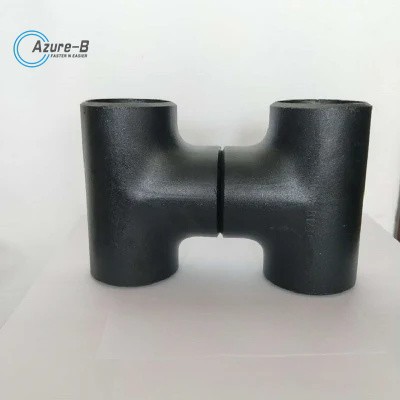
As a leading supplier of Buttweld Equal Tees, we offer a wide range of products with different hardness levels to meet the diverse needs of our customers. Our Equal Tee products are made from high - quality materials and undergo strict quality control processes to ensure consistent hardness and excellent performance.

In addition to Equal Tees, we also provide ASME B16.9 Unequal Tee and Steel Reducing Tee Pipe Fittings, which are designed to meet the specific requirements of various piping systems. Our team of experts can provide professional advice on material selection, heat treatment, and hardness control to ensure that you get the most suitable products for your applications.
Conclusion
In conclusion, the hardness of a Buttweld Equal Tee is a complex property that is influenced by material composition, heat treatment, and manufacturing process. Understanding the concept of hardness and its significance in practical applications is essential for selecting the right Buttweld Equal Tees for your piping systems.
If you are interested in our Buttweld Equal Tees or have any questions about hardness and other aspects of these products, please feel free to contact us for further discussion and procurement negotiation. We are committed to providing you with high - quality products and excellent service.
References
- ASM Handbook Volume 8: Mechanical Testing and Evaluation. ASM International.
- Perry, R. H., & Green, D. W. (Eds.). (1997). Perry's Chemical Engineers' Handbook. McGraw - Hill.
- Callister, W. D., & Rethwisch, D. G. (2012). Materials Science and Engineering: An Introduction. Wiley.