

What are the requirements for the welding electrodes when welding a 90 deg elbow?
Sep 18, 2025
Leave a message
Hey there! I'm a supplier of Welded 90 Deg Elbow, and today I wanna talk about the requirements for the welding electrodes when welding a 90 deg elbow.
Compatibility with Elbow Material
First off, the most crucial thing is the compatibility of the welding electrode with the material of the 90 deg elbow. We usually deal with carbon steel for our Welded 90 Deg Elbow. When welding carbon steel elbows, you gotta pick electrodes that match the carbon content and other alloying elements of the elbow material.
For low - carbon steel elbows, electrodes like E6010 or E6013 are commonly used. E6010 electrodes are great for deep penetration welding. They can handle dirty or rusty surfaces pretty well, which is handy when you're working in real - world conditions. On the other hand, E6013 electrodes are more suitable for welding thinner sections of low - carbon steel. They produce a smooth and clean weld bead, making the finished product look good.
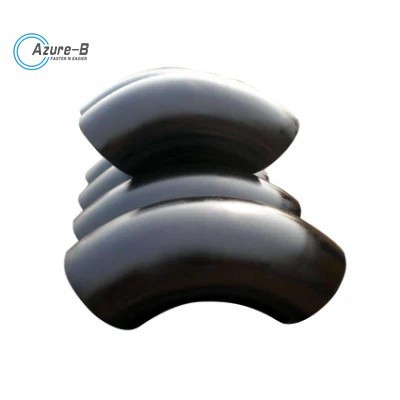

If we're talking about high - strength carbon steel elbows, electrodes such as E7018 are a better choice. E7018 provides high - quality welds with good mechanical properties. It can withstand high stress and is often used in applications where the elbow will be under a lot of pressure.
Welding Position
The welding position also plays a big role in electrode selection. When welding a 90 deg elbow, you might encounter different positions like flat, horizontal, vertical, and overhead.
For flat position welding, you have more options. Electrodes that offer high deposition rates can be used because in the flat position, it's easier to control the molten metal. For example, some heavy - coated electrodes can be used to deposit a large amount of filler metal quickly.
In horizontal position welding, electrodes need to have good slag control. The slag should flow properly to prevent it from interfering with the weld pool. Electrodes with a fast - freezing slag system are often preferred. This helps keep the molten metal in place and ensures a smooth weld.
Vertical and overhead positions are more challenging. You need electrodes that can handle the force of gravity. Electrodes with a high - cellulose coating, like E6010, are suitable for vertical down welding. They have a deep - penetrating arc that can hold the molten metal against gravity. For vertical up and overhead welding, low - hydrogen electrodes such as E7018 are often used. They produce a strong weld that can withstand the stress even in these difficult positions.
Weld Quality Requirements
The quality requirements of the final weld also determine the choice of electrodes. If the weld needs to meet certain industry standards, like those in the oil and gas or construction industries, you have to be very careful with electrode selection.
For example, in the oil and gas industry, welds on elbows need to be highly resistant to corrosion and cracking. Low - hydrogen electrodes are often specified because they produce welds with low hydrogen content, which reduces the risk of hydrogen - induced cracking. These electrodes also have good toughness and ductility, which are important properties for pipes that will carry fluids under high pressure.
In construction projects, the appearance of the weld might also be a factor. If the elbow is going to be visible, you'll want an electrode that can produce a clean and aesthetically pleasing weld. As mentioned earlier, E6013 electrodes are good for this purpose as they leave a smooth and neat weld bead.
Welding Equipment and Process
The type of welding equipment and process you use also affect electrode selection. If you're using a shielded metal arc welding (SMAW) process, which is a common method for welding elbows, you need electrodes that are compatible with this process.
SMAW electrodes come in different diameters. Smaller diameter electrodes, like 1/16 - inch or 3/32 - inch, are good for welding thin - walled elbows or for making root passes. Larger diameter electrodes, such as 1/8 - inch or 5/32 - inch, are used for filling and cap passes when you need to deposit more filler metal.
If you're using a gas - shielded welding process, like gas metal arc welding (GMAW) or flux - cored arc welding (FCAW), the electrode requirements change. For GMAW, you use solid wire electrodes, and for FCAW, you use flux - cored wires. These electrodes are often designed to work with specific shielding gases. For example, when using GMAW to weld carbon steel elbows, a mixture of argon and carbon dioxide is commonly used as the shielding gas.
Cost Considerations
Let's not forget about cost. As a supplier, I know that cost is always a factor for our customers. Some electrodes are more expensive than others. For example, low - hydrogen electrodes like E7018 are generally more costly than regular carbon steel electrodes like E6013.
If the application doesn't require extremely high - quality welds or if the budget is tight, you might be able to get away with using less expensive electrodes. But you have to make sure that the electrodes still meet the basic requirements for the welding job. It's all about finding the right balance between cost and quality.
Conclusion
In conclusion, when welding a 90 deg elbow, there are several factors to consider when choosing the welding electrodes. Compatibility with the elbow material, welding position, weld quality requirements, welding equipment and process, and cost all play important roles.
As a supplier of Welded 90 Deg Elbow, I understand the importance of providing high - quality products. And the right welding electrodes are a key part of ensuring that our elbows are welded properly. If you're in the market for Buttweld Elbow or Seamless 90° Pipe Elbow and have questions about welding, feel free to reach out. We're here to help you make the best choices for your projects. Whether you're a small - scale contractor or a large - scale industrial client, we can work with you to meet your needs. So, don't hesitate to contact us for more information and to start a procurement discussion.
References
- AWS Welding Handbook, Volume 2: Welding Processes
- Welding Metallurgy and Weldability of Stainless Steels by John C. Lippold and David J. Kotecki
- The Welding Institute (TWI) Technical Reports on Pipe Welding