

How to use a Buttweld Straight Tee to control acoustic waves?
Nov 20, 2025
Leave a message
Acoustic waves play a crucial role in various industrial and scientific applications, from noise control in HVAC systems to ultrasonic testing in manufacturing. As a leading supplier of high - quality Buttweld Straight Tee products, I am excited to share insights on how these components can be effectively used to control acoustic waves.
Understanding Acoustic Waves and Their Challenges
Acoustic waves are mechanical waves that propagate through a medium, such as air, water, or solids. In industrial settings, these waves can cause noise pollution, interfere with sensitive equipment, and even lead to structural damage over time. Controlling acoustic waves is, therefore, essential for maintaining a safe and efficient working environment.
One of the main challenges in acoustic wave control is the ability to manipulate the waves' direction, amplitude, and frequency. Traditional methods often involve the use of sound - absorbing materials or barriers, but these solutions may not be sufficient in all cases. This is where Buttweld Straight Tee comes into play.

How Buttweld Straight Tee Works in Acoustic Wave Control
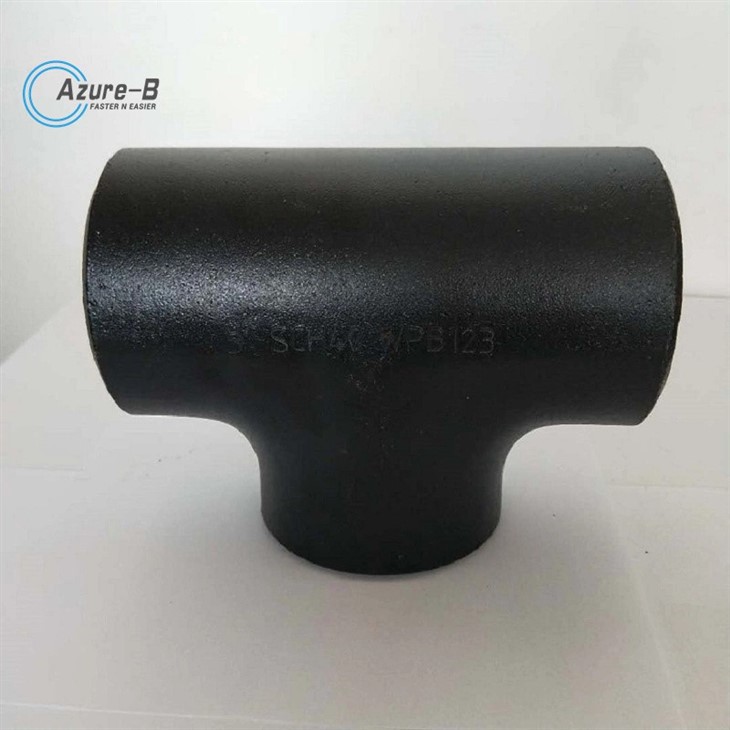
A Buttweld Straight Tee is a type of pipe fitting that has a straight branch at a 90 - degree angle to the main run. This unique design allows it to have a significant impact on the propagation of acoustic waves.
Wave Reflection and Redirection
When an acoustic wave encounters a Buttweld Straight Tee, part of the wave is reflected back, and part is redirected into the branch. The amount of reflection and redirection depends on several factors, including the material of the tee, the angle of incidence of the wave, and the frequency of the wave. For example, in a piping system, if the main pipe is carrying fluid with acoustic waves, the Buttweld Straight Tee can be strategically placed to redirect the waves into a secondary pipe, reducing the noise level in the main pipe.
Wave Interference
The Buttweld Straight Tee can also create wave interference. When the reflected and redirected waves interact with each other, they can either reinforce or cancel each other out. By carefully designing the dimensions and placement of the tee, we can achieve constructive or destructive interference. In noise control applications, destructive interference is often desired, as it can significantly reduce the overall sound level. For instance, in an HVAC duct system, placing Buttweld Straight Tees at specific intervals can create destructive interference patterns that minimize the noise transmitted through the ducts.
Frequency Filtering
Different frequencies of acoustic waves interact with the Buttweld Straight Tee in different ways. The tee can act as a frequency - selective filter, allowing certain frequencies to pass through while attenuating others. This property is particularly useful in applications where specific frequency ranges need to be controlled. For example, in ultrasonic testing, where different frequencies are used to detect different types of defects in materials, a Buttweld Straight Tee can be used to filter out unwanted frequencies, improving the accuracy of the testing.
Factors Affecting the Performance of Buttweld Straight Tee in Acoustic Wave Control
Material Properties
The material of the Buttweld Straight Tee has a significant impact on its acoustic performance. Metals such as carbon steel are commonly used due to their high strength and durability. Carbon steel tees can efficiently reflect and redirect acoustic waves, but they also have some inherent damping properties that can absorb a certain amount of energy from the waves. Other materials, such as stainless steel, may offer different acoustic characteristics, including better corrosion resistance and different levels of wave absorption.
Size and Geometry
The size and geometry of the Buttweld Straight Tee are crucial factors. The diameter of the main pipe and the branch, as well as the wall thickness of the tee, can affect the way acoustic waves interact with it. A larger - diameter tee may be more effective in handling high - amplitude waves, while a tee with a thinner wall may have different wave - absorption properties. Additionally, the length of the branch can also influence the wave interference patterns created by the tee.
Installation and Placement
Proper installation and placement of the Buttweld Straight Tee are essential for optimal acoustic wave control. In a piping system, the tee should be installed in a way that minimizes turbulence and ensures a smooth flow of fluid. The placement of the tee relative to the source of the acoustic waves and other components in the system can also have a significant impact. For example, in a complex piping network, placing the tee close to the source of noise can help to capture and control the waves before they spread throughout the system.
Comparison with Other Pipe Fittings
Buttweld Equal Tee
A Buttweld Equal Tee has equal - sized branches and main run. While it also has some acoustic wave - controlling capabilities, the straight - branch design of the Buttweld Straight Tee gives it an advantage in terms of wave redirection. The 90 - degree straight branch of the Buttweld Straight Tee allows for more precise control of the wave direction, making it more suitable for applications where specific wave - redirection patterns are required.
ASME B16.9 Unequal Tee
The ASME B16.9 Unequal Tee has branches of different sizes. This design can be used for flow - distribution purposes, but its acoustic performance may be more complex. The unequal - sized branches can create more complex wave - interference patterns, which may be either beneficial or detrimental depending on the application. In general, the Buttweld Straight Tee offers a more straightforward and predictable acoustic performance, making it a preferred choice for many acoustic wave - control applications.
Applications of Buttweld Straight Tee in Acoustic Wave Control
HVAC Systems
In heating, ventilation, and air - conditioning (HVAC) systems, noise reduction is a critical issue. Buttweld Straight Tees can be used in ductwork to control the propagation of acoustic waves generated by fans, compressors, and other equipment. By strategically placing the tees, we can reduce the noise level in occupied spaces, improving the comfort of building occupants.
Industrial Piping Systems
In industrial settings, piping systems often carry fluids with high - velocity flows, which can generate significant acoustic waves. Buttweld Straight Tees can be used to control these waves, reducing noise pollution in the workplace and protecting the integrity of the piping system. For example, in a chemical processing plant, the tees can be used to manage the noise generated by pumps and valves.
Ultrasonic Testing
In ultrasonic testing, Buttweld Straight Tees can be used to filter and control the acoustic waves used for defect detection. By using the tee to select specific frequencies and redirect the waves, we can improve the accuracy and reliability of the testing process.
Conclusion
As a supplier of Buttweld Straight Tee products, I understand the importance of providing high - quality fittings that can effectively control acoustic waves. The unique design of the Buttweld Straight Tee offers several advantages in terms of wave reflection, redirection, interference, and frequency filtering. By considering factors such as material properties, size and geometry, and installation and placement, we can optimize the performance of the tee in various acoustic wave - control applications.
If you are interested in using Buttweld Straight Tees for acoustic wave control in your projects, I encourage you to reach out for a detailed discussion. We can work together to determine the most suitable tee for your specific needs and ensure that you achieve the best possible results in acoustic wave management.
References
- Beranek, Leo L., and Tim M. Ver, Noise and Vibration Control Engineering: Principles and Applications. Wiley, 2012.
- Kinsler, Lawrence E., et al., Fundamentals of Acoustics. Wiley, 2000.
- Incropera, Frank P., et al., Fundamentals of Heat and Mass Transfer. Wiley, 2017.