

How is a Buttweld Straight Tee different from other types of tees?
Sep 17, 2025
Leave a message
Hey there! I'm a supplier of Buttweld Straight Tees, and today I want to talk about how these bad boys are different from other types of tees. If you're in the market for tees for your piping system, understanding these differences can help you make the right choice.
What's a Buttweld Straight Tee?
First off, let's quickly go over what a Buttweld Straight Tee is. It's a type of pipe fitting that has three openings, all of the same diameter. The name "buttweld" comes from the way it's connected to the pipes – by butt welding. This means the ends of the tee are welded directly to the ends of the pipes, creating a strong and leak - proof joint. It's commonly used in piping systems where a straight flow division is required, like in water supply systems, oil and gas pipelines, and industrial processing plants.
Comparing with Butt Weld Reducing Tee
Now, let's compare it with a Butt Weld Reducing Tee. As the name suggests, a Butt Weld Reducing Tee has one opening that's smaller in diameter than the other two. This is useful when you need to reduce the flow rate in one of the branches of the piping system.
For example, in a water distribution system, if you have a main pipe that supplies water to multiple smaller pipes, a Butt Weld Reducing Tee can be used to connect the main pipe to the smaller ones. The larger opening is connected to the main pipe, and the smaller opening is connected to the branch pipe.
In contrast, a Buttweld Straight Tee has all openings of the same size. So, it doesn't change the flow rate based on the fitting itself. It simply divides the flow equally among the three branches (assuming the same pressure and fluid properties in all directions). If you need to maintain a consistent flow rate in all branches of your piping system, a Buttweld Straight Tee is the way to go.
Comparing with Buttweld Reducing Tee
The Buttweld Reducing Tee is also similar to the Butt Weld Reducing Tee we just talked about. It's designed for situations where you need to reduce the size of the pipe in one of the branches.
The main difference between a Buttweld Straight Tee and a Buttweld Reducing Tee lies in their functionality. A Buttweld Straight Tee is like a fair - share distributor. It takes the incoming fluid and distributes it evenly to all three directions. On the other hand, a Buttweld Reducing Tee is more of a flow - adjuster. It allows you to adjust the flow rate by reducing the size of one of the outlets.
In terms of installation, a Buttweld Straight Tee is generally easier to install when all the pipes in the system are of the same size. You don't have to worry about matching different pipe diameters. With a Buttweld Reducing Tee, you need to make sure the pipe sizes are compatible and that the welding is done correctly to avoid any leaks or flow restrictions.
Comparing with Equal Tee
An Equal Tee might seem similar to a Buttweld Straight Tee at first glance. Both have three openings of the same size. However, the key difference lies in the manufacturing process and the connection method.
An Equal Tee can be made using different manufacturing processes, such as casting or forging. And it can be connected to the pipes using different methods like threaded connections or socket welding.
A Buttweld Straight Tee, as I mentioned earlier, is specifically designed for butt welding. This welding method provides a stronger and more reliable connection compared to some other methods. It also results in a smoother internal surface, which reduces the chances of turbulence and pressure drop in the piping system.
In applications where high pressure and a clean flow are required, a Buttweld Straight Tee is often preferred over an Equal Tee. For example, in high - pressure steam systems or in chemical processing plants where the fluid needs to flow smoothly without any obstructions, a Buttweld Straight Tee can offer better performance.
Advantages of Buttweld Straight Tees
One of the biggest advantages of Buttweld Straight Tees is their strength. The butt - welding process creates a joint that's as strong as the pipe itself. This means it can withstand high pressures and temperatures without leaking or failing.
They also offer a smooth flow path. Since there are no abrupt changes in diameter or connection points that could cause turbulence, the fluid can flow through the tee more easily. This is important in applications where energy efficiency is a concern, as less energy is wasted in overcoming flow resistance.
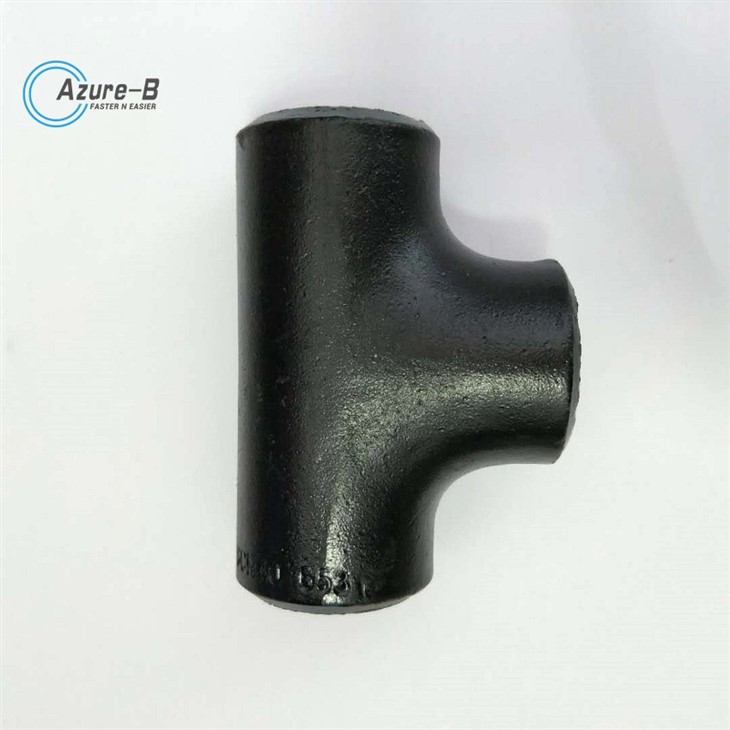

Another advantage is their durability. The welded joints are resistant to corrosion and mechanical damage. So, Buttweld Straight Tees can have a long service life, reducing the need for frequent replacements.
When to Choose a Buttweld Straight Tee
If you're working on a piping system where all the pipes are of the same size and you need to divide the flow evenly, a Buttweld Straight Tee is a great choice. It's also ideal for high - pressure and high - temperature applications where a strong and reliable connection is essential.
For example, in a power plant's cooling water system, where large - diameter pipes are used to circulate water, a Buttweld Straight Tee can be used to distribute the water to different parts of the system. The equal flow division ensures that all components receive an adequate supply of water for cooling.
Conclusion
In conclusion, a Buttweld Straight Tee is unique in its own way compared to other types of tees. It offers equal flow division, a strong welded connection, and a smooth flow path. While Butt Weld Reducing Tees and Buttweld Reducing Tees are great for adjusting flow rates, and Equal Tees have their own installation advantages, the Buttweld Straight Tee shines in applications where strength, even flow, and high - performance are required.
If you're interested in purchasing Buttweld Straight Tees for your project, I'd love to have a chat with you. Whether you have questions about sizing, installation, or just want to get a quote, feel free to reach out. Let's work together to find the best solution for your piping needs.
References
- Pipe Fitting Handbook: A Comprehensive Guide to Pipe Fittings and Their Applications
- Industrial Piping Systems: Design, Installation, and Maintenance